Posts

Showing posts with the label Culture

Introduction to Chinese Seal Carving (3)

Image
The flourishing of seal carving by esteemed scholars brought Chinese seal carving into a new ear. Given the artistic standards of seal carving of the Qin and Han Dynasties, some scholars widely used the stone for seal carving to express their feelings and thinkings from the Ming Dynasty. Accordingly, a new technique of expression took shape. Meanwhile, different schools of seal carving were founded throughout the county. Wen Peng (Chinese: 文彭), He Zheng (Chinese: 何震), Zhu Jian (Chinese: 朱簡) and Wang Guan (Chinese: 汪關), accomplished masters of seal carving in the Ming Dynasty, represented the highest level of then seal carving. Many schools with different artistic styles were established in the Qing Dynasty. Xiling Seal-Engraving Society (Chinese: 西冷印社) had a great influence upon the development seal carving in the middle of the Qing Dynasty. Ding Jing (Chinese: 丁敬) is the outstanding representative of that society. The society founded by Deng Shi-ru (Chinese: 鄧石如) expanded rapidly in l...

Introduction to Chinese Seal Carving (2)

Image
Chinese royal seal has a long history. In the late part of the Shang Dynasty (Chinese: 商朝), bronze royal seal had already appeared. The seals were extensively used as a token in the daily life during the Spring and Autumn Period (Chinese: 春秋時代) and the Warring States Period. With the development of casting technique, the craftsmanship of bronze seals was greatly improved. Moreover, the specialized skills brought about exquisite composition of the inscription, which comprehensively reflected then cultural background. The ancient royal seals with the distinctive regionalism, made in the Warring States Period, were the seals with free and natural inscription and diversified knobs of the seals. It was envisaged that more attention was paid to the sense of beauty of the seals during that period. Seal carving reached a new peak during the Qin and Han Dynasties (Chinese: 秦漢). The unified and comprehensive system of official seal carving came into being as a result of the promulgation of offic...

Introduction to Chinese Seal Carving

Image
Chinese seal carving, the hybrid of calligraphy and carving, is a peculiar art with distinctive national style. Generally speaking, composition of inscription and sharp of the knob of seal embody the splendid artistic style of Chinese ancient seal carving. In addition, the side inscription and the natural beauty of the seal had been paid more and more attention since the Ming and Qing Dynasties (Chinese: 明清). Therefore, with the development of Chinese seal carving, the characteristic aesthetic standard came into being. Ancient seals were mainly made of bronze. In addition, other materials were often used to carve seals, which included gold, silver, jade, porcelain, horn, wood and stone. Bronze seals were made by the way of casting and chiseling. Ancient seals could be classified into official seals and personal seals for their function. During the Warring States Period (Chinese: 戰國時代), the popular idioms were often adopted as the inscriptions of seals. The earliest seals, "Xiaoxin...

Handcraft Papercutting

Image
In Beijing, one of the most impressive folk arts is the papercutting (Chinese: 剪紙). It is the handcraft of Chinese people which use a skillful and creative technique to cut the paper and turn it to a very attractive decoration on the doors, windows, columns, walls and lamps. Every time when I visit Beijing, I take many photos for the papercuttings as they are very beautiful and unique. Checking the history, the tradition for papercutting was started in 6th century. It was served for religious purpose at first. There are two ways for doing the papercuttings: scissors method and knife method. Today, papercuttings are chiefly used as decoration in many special events, like Chinese New Year, Marriage and cerebrate the birthday. There is a quite funny study: In the countryside, papercuttings are usually made only by women and girls. This used to be one of the crafts that every girl was to master and that were often used to judge brides. Professional papercutting artists are, on the other h...

Carving a Chinese Seal

Image
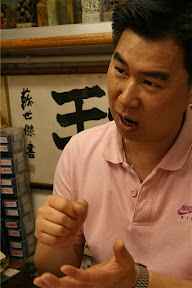
By a small graver, Uncle Chun, from Man Wa Lane, is simply sculpturing on stones bringing out five-thousand-year Chinese culture implicitly. When Uncle Chun was about ten years old, he formally became a pupil to a master to learn a craft for almost 20 years. When recalling the memories in those years, he spoke the joy and sorrow for learning carving excitedly. For craving a seal, you not only need to know the penmanship, but also have to learn different ways in manufacturing and how to handle different fonts of writing. "Even if you have a beautiful handwriting, it doesn’t mean that you can become a famous craftsman." Uncle Chun was speaking slowly and tirelessly. Penmanship is just a small part for making a seal since the word is written in a reverse way. Moreover, you have to use a carving tool instead of a writing brush; writing on a stone instead of one piece of paper. Besides, the font for craving is quite different from writing and therefore we cannot just copy and pa...

Arranque from Hong Kong

Hong Kong is the mixture of the East and the West. When these two distinct cultures collide, what's the cultural singularity in this hybrid city? The answer is "Arranke". Arranke is the transformation of Spanish word, arranque, which means a starting point. Meanwhile, the inside "k" is the initial K of the abbreviation of Hong Kong – Kong. We, Hongkongers, call our city as "Kong" for short. Arranke, thus, is our beginning of Hong Kong Chinese culture. Let's go!